Master Your Feed: The Ultimate Social Media Content Canva Template
Visualizing Your Brand's Digital Blueprint
There is a distinct difference between merely posting on social media and actually building a cohesive digital presence. Many creators and entrepreneurs face the daily friction of the "blank page syndrome"—staring at an empty canvas, unsure of what to post, how to style it, or whether it fits the overall aesthetic. This is where a robust Social Media Content Canva Template shifts the paradigm. It is not just a collection of boxes on a calendar; it is a comprehensive design asset that serves as the structural backbone for your brand identity. By integrating visual planning with strategic scheduling, this tool allows you to treat your feed like a cohesive editorial spread rather than a disjointed series of isolated images.
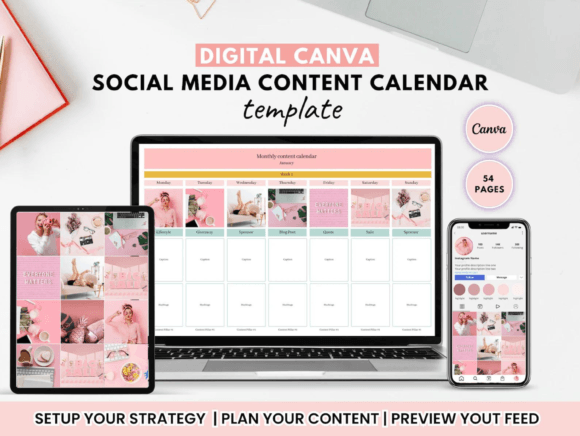
Visually, the template embodies modern typography principles, favoring clarity and organization. It typically utilizes a clean grid system that mirrors the actual layout of an Instagram feed, allowing you to see exactly how colors and subjects interact when placed next to one another. The personality of the template is professional yet approachable, designed to be a functional workspace rather than a distraction. It leverages sans serif font pairings for UI elements to ensure maximum legibility, while leaving ample room for your own creative font choices—whether that be a bold display font for headers or a delicate script font for overlays. The overall appeal lies in its ability to tame the chaos of content creation, offering a visual sanctuary where strategy and aesthetics meet.
Strategic Organization: Beyond the Grid
The true value of this Social Media Content Canva Template lies in its multi-layered utility. It goes far beyond simple scheduling. The "Setup Page" is a critical starting point, prompting you to define your visual language before you even begin to plan posts. This is where you solidify your brand identity, inputting your specific hex codes, selecting your primary typeface, and uploading your logo variations. By doing this upfront work, you ensure that every subsequent piece of content adheres to your style guide, fostering the recognition and consistency that audiences crave.
Furthermore, the inclusion of an "Idea Bank" is a nod to the reality of the creative process. Inspiration strikes at odd hours, and without a dedicated repository, those sparks often fade. This section allows you to dump raw concepts, save reference images, and jot down caption drafts. It acts as a staging ground before content moves to the formal calendar. The "Brand Board" section reinforces this by serving as a constant visual anchor. When you are deep in the weeds of daily posting, it is easy to drift from your original aesthetic. Having a dedicated space to view your logo, color palette, and core fonts ensures that your visual hierarchy remains consistent, preventing your feed from looking fragmented or amateurish.
Practical Applications and Workflow Optimization
For the busy entrepreneur or the multi-client marketer, time is the most valuable commodity. The drag-and-drop nature of Canva, combined with the structured layout of this template, drastically reduces the friction of content production. Imagine the workflow: you select a content pillar, determine the format (carousel, reel cover, static post), and set the intention. You then drag your photography or graphics into the pre-sized feed placeholders. This immediate visual feedback allows you to spot clashes in color temperature or composition instantly. If a bright, saturated image sits next to a muted, pastel graphic, you will see the dissonance immediately and can swap assets before publishing.
This template is particularly effective for projects involving packaging design or product launches. You can visualize how a product shot looks alongside educational content or user-generated testimonials. It is also invaluable for editorial design on digital platforms; publishers can plan a week’s worth of article graphics to ensure headlines are legible and images are compelling. The versatility extends to web design previews and logo design applications, where you might want to see how a new logo mark performs as a profile picture versus a watermark on a graphic. By utilizing the "Growth Tracker" included in the package, you move from guessing to knowing. You can correlate specific visual styles or font pairings with engagement metrics, refining your approach based on data rather than intuition.
Elevating Your Visual Hierarchy and Readability
A common pitfall in DIY social media graphics is poor visual hierarchy. When a post is cluttered, the message gets lost. This Social Media Content Canva Template encourages a disciplined approach to layout. By pre-defining your typography styles—perhaps using a bold serif font for impact and a clean sans-serif for body text—you create a rhythm that the eye can easily follow. This is where the concept of premium font usage becomes practical. High-quality typefaces often come with various weights (light, regular, bold, black) that allow you to create contrast without introducing new fonts, which can clutter the design.
Consider the readability on mobile devices. A handwritten font might look charming on a desktop monitor but can become illegible on a small phone screen if used for critical information. The template encourages you to test these pairings within the "Feed Planner" view, simulating the actual mobile experience. This iterative process of testing and refining is what separates professional content from amateur efforts. It helps you understand that a creative font is not just about style; it is about communication. Whether you are a crafter selling goods on Etsy or a consultant building authority, the way you present your text influences how your audience perceives your competence.
Customization for Niche Markets
The adaptability of this Social Media Content Canva Template makes it suitable for a wide array of industries. For a food blogger, the focus might be on the "Feed Planner" to ensure a consistent color temperature across food photography, using the brand board to match typography overlays to the warm or cool tones of the food. For a fitness coach, the "Content Calendar" is essential for balancing motivational quotes, workout videos, and client transformations, ensuring the feed doesn't become monotonous.
Designers can use the template to mock up social media graphics for client presentations, offering a tangible preview of how a campaign will look in the wild. This elevates the perceived value of the service. For those involved in commercial font sales or digital asset marketplaces, the template serves as a brilliant vehicle to showcase fonts in context. Instead of showing a font on a plain white background, you can display it within a realistic social media environment, helping customers visualize the typeface in action. This application of design assets creates a richer, more persuasive narrative around the products you sell.
Conclusion: A Foundation for Sustainable Growth
Ultimately, the goal of any Social Media Content Canva Template is to remove the mental load of content creation. It provides a framework that supports consistency, which is the key to building trust and recognition online. By taking the guesswork out of layout, color matching, and scheduling, you free up cognitive space to focus on what truly matters: connecting with your audience. It transforms the chaotic task of "posting" into a streamlined, strategic operation. Whether you are managing a personal brand or a corporate account, this tool provides the structure needed to maintain a polished, professional presence that stands out in a crowded digital landscape.