Letter B Activity Book Worksheets: Building Foundational Skills
More Than Just a Letter: The Educational Value of B
In the world of early childhood education, the "Letter B Activity Book Worksheets" represent a cornerstone of literacy development. As a creative professional, I view these assets not merely as printables, but as essential design tools for educators, parents, and content creators aiming to facilitate engaging learning environments. The core objective of this unit is to bridge the gap between abstract symbols and phonetic reality. By focusing on the letter B, specifically the short sound /b/, this collection provides a structured yet playful approach to phonics. It moves beyond rote memorization, encouraging children to interact with the letter through tactile and visual stimuli. For the adult audience—whether you are a homeschooling parent, a preschool teacher, or a publisher of educational content—understanding the mechanics of these worksheets is key to unlocking a child's reading potential.
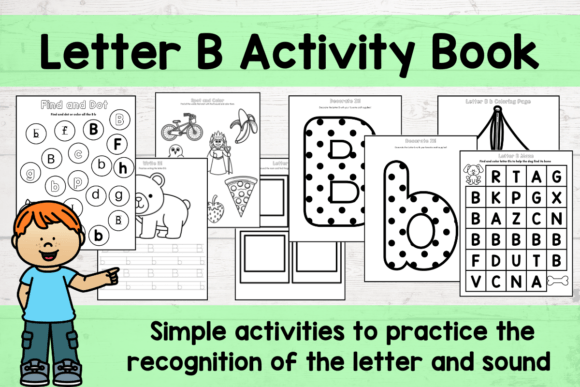
The design philosophy behind these worksheets emphasizes recognition and association. The "Find and Dot B and a with different fonts" activity is particularly brilliant from a design perspective. It exposes young learners to typographic variety early on, teaching them that the letter 'B' remains a 'B' regardless of whether it is in a serif font, a sans serif font, or a script style. This builds cognitive flexibility. Similarly, the "Color the pictures that start with B" section reinforces auditory association with visual cues, a critical step in early reading development. These aren't just coloring pages; they are carefully constructed learning modules disguised as fun activities.
Anatomy of the Activities: Practical Applications
Let’s break down the specific components included in this unit, as each serves a distinct purpose in the learning journey. The "Letter B large tracing page with apple" is designed for gross motor skill development. The large surface area allows children to practice the motion of the letter without the constraints of small lines, helping them internalize the shape of the capital B and lowercase b. Following this, the "Trace lowercase and uppercase B and color the astronaut" activity refines these skills, introducing the concept of spatial boundaries and precision.
Creativity plays a massive role in retention. The "Decorate the capital letter B" and "Decorate the lowercase letter b" activities invite the use of favorite craft supplies. This is where the worksheets transcend standard pen-and-paper tasks. By incorporating collage, glitter, or textured materials, you are engaging multiple senses, which solidifies the memory of the letter's shape. For the content creator or teacher, this is an opportunity to discuss the visual weight and structure of the letter—turning a simple craft into a lesson on graphic design fundamentals.
The unit also includes "Draw something that starts with B" and "Draw 4 things around the room that start with the letter B." These open-ended prompts are invaluable for assessing comprehension. They require the child to access their vocabulary, filter it for the specific sound, and translate that thought into a visual representation. This mirrors the creative process used by designers and marketers when brainstorming brand assets. Finally, the "Capital letter B maze" and "Lowercase letter b maze" offer a gamified approach to problem-solving and visual tracking, essential skills for reading fluency.
Integrating These Assets into Your Workflow
For the entrepreneur, small business owner, or blogger in the education niche, the "Letter B Activity Book Worksheets" are versatile design assets. They can be utilized to create lead magnets for email lists, sold as part of a comprehensive homeschool curriculum, or used as engaging content for social media graphics. The aesthetic appeal of these worksheets—typically clean, bold, and kid-friendly—makes them easy to integrate into various branding strategies. If your brand identity revolves around education, parenting, or creative play, these worksheets serve as authentic proof of your value proposition.
When incorporating these into a larger project, consider the typography and layout of your surrounding content. If you are publishing a digital magazine or an editorial design piece, ensure that the introduction to these activities uses a complementary typeface. A playful sans serif font or a friendly handwritten font often pairs well with educational materials, maintaining a tone that is approachable yet professional. The goal is to create a seamless user experience where the worksheet feels like a natural extension of your brand’s voice.
Design Considerations for Print and Digital Use
From a practical standpoint, the "Letter B Activity Book Worksheets" are optimized for both print and digital environments. When printing, ensure your settings are calibrated for high-resolution output, especially if the pages include intricate details like the mazes or the font variations in the "Find and Dot" activity. For digital distribution, such as on a website or via a tablet app, consider how the PDF layout translates to vertical scrolling. While the worksheets are designed for print, they can be adapted for digital annotation using stylus-friendly apps, making them a flexible tool for modern educators.
Furthermore, the inclusion of diverse activities—from tracing to drawing to mazes—allows for a modular approach to lesson planning. You don't have to use the entire workbook in one sitting. Instead, you can select specific pages to target particular skills. For instance, if a child is struggling with fine motor control, the tracing pages are your go-to. If they need to work on vocabulary and creativity, the drawing prompts are ideal. This modularity is a hallmark of good instructional design, providing adaptability for various learning styles and paces.
The Bigger Picture: Literacy as a Foundation
Ultimately, the "Letter B Activity Book Worksheets" are about more than just the second letter of the alphabet. They are about building confidence. Every time a child successfully traces a line, dots a letter, or identifies a word that starts with B, they are reinforcing their ability to learn. This psychological aspect is as important as the educational content. For the adult guiding them, these worksheets provide a structured roadmap, reducing the guesswork involved in teaching early literacy. They are a testament to the power of combining thoughtful graphic design with sound educational theory.
In a market saturated with generic educational materials, these worksheets stand out by offering a comprehensive, multi-faceted approach to a single letter. They respect the child's intelligence by offering varied challenges and respecting the educator's time by providing ready-to-use, visually appealing resources. Whether you are a parent looking for rainy-day activities, a teacher supplementing your phonics curriculum, or a creator developing a product line, the value of a well-executed activity book cannot be overstated.